Long-View Student Wins 1st in the Nation for Mathematics and Wins Team Award for Collaboration at the Science Fair

Yesterday, Thermo Fisher Scientific and Society for Science announced the winners of the Thermo Fisher Scientific Junior Innovators Challenge (Thermo Fisher JIC), the nation’s leading middle school science, technology, engineering and math (STEM) competition.

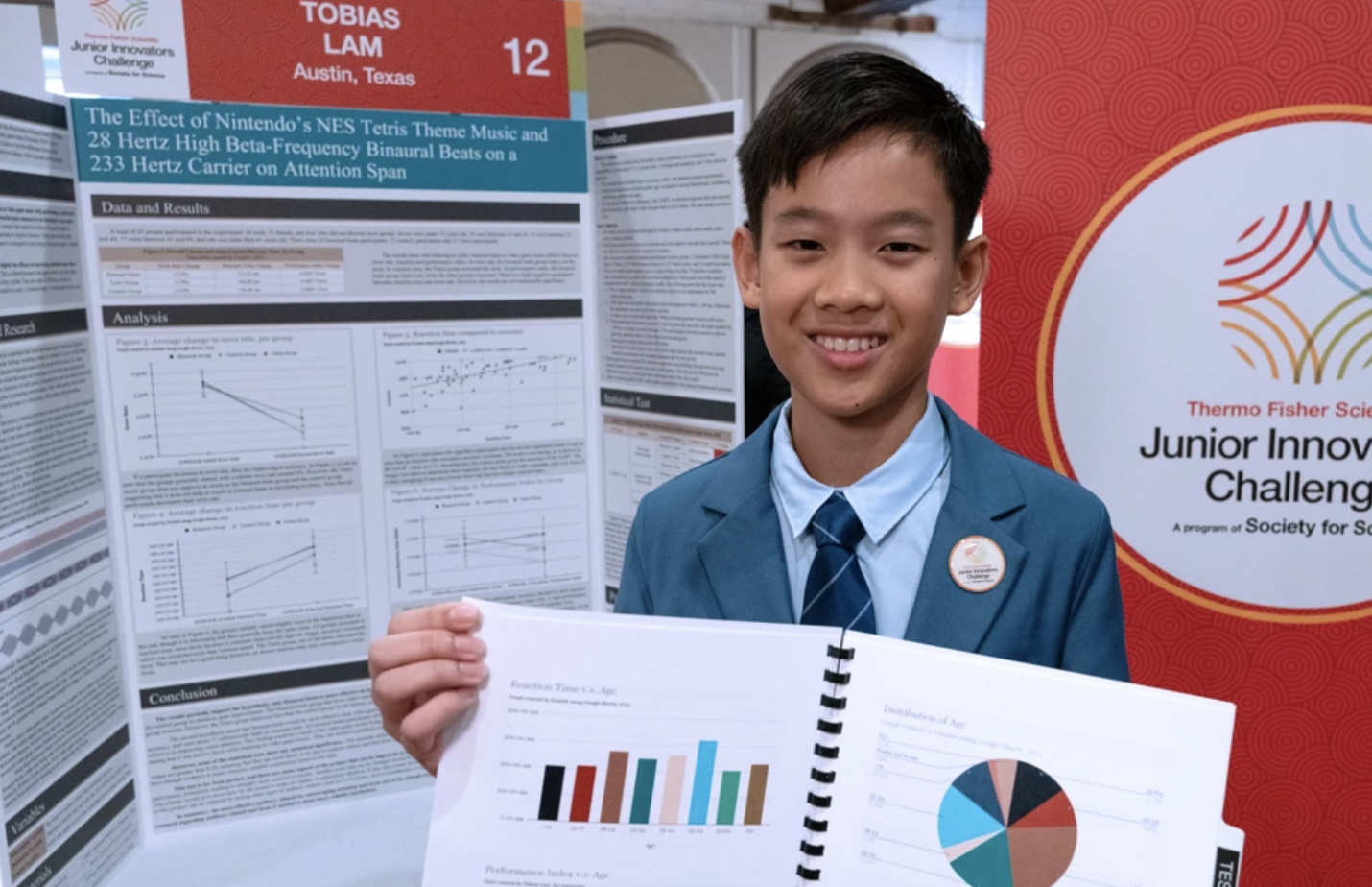
Tobias (Toby) Lam, representing Long-View Micro School, won the First Place Mathematics Award, as well as the Team Award!

Toby demonstrated exceptional skill and promise in mathematics as evidenced in his project, titled “The Effect of Nintendo’s NES Tetris Theme Music and 28 Hertz High Beta-Frequency Binaural Beats on a 233 Hertz Carrier on Attention Span,” and was awarded First Place in Mathematics. Listen to Toby describe his project here. 

Furthermore, Toby’s Finals Week challenge team won the Team Award because they best demonstrated an ability to work together and solve problems through shared decision making, communication and scientific and engineering collaboration.

Exceptional math skills and strong collaboration skills sound exactly like what we are teaching at Long-View Micro School!

Read More
"Spend a Day" With A Band: Instagram Highlights As A Way to Experience Learning At Long-View

“Long-View develops thinking skills, agency, curiosity, and investment in learning. We focus on constructing robust knowledge structures and facilitating the development of conceptual understandings that promote transfer and connections. “ That’s the big picture of what we are working to do. But what does that look like on a daily basis? If Long-View is a transformative educational experience, one that is built upon a cohesive experience across weeks, months, and years, what does one day look like?

To answer these questions, we’ve put together four highlights. In each highlight, we follow one group of learners for their day at Long-View. 

Before you watch these highlights that follow each band, you might be wondering about how bands are formed. Each band typically has a spread of 2-3 grade levels. Mixed-age bands allow us to let go of assumptions related to ages and grade levels and ensure all children are stretching toward the highest expectations. We have four bands, which are created in the beginning of the year and typically have color names (ex. “Indigo Band”). The band operates as a learning community across all subject areas. If you’d like to learn more about how we think about band placement, you can see our most recent blog post….

Read More
Bigs Reflect on Their Mathematical Journeys

It’s Day One! This morning kicked off the 2025-26 iteration of Long-View’s Big + Little Math. For the past six years, a group of Long-View’s older mathematicians (known as Bigs, typically 7th and 8th graders) have met with a group of the youngest (known as Littles, typically 2nd and 3rd graders) in partnerships every Thursday morning from 8:30-9:30. As detailed in an earlier post by Astrid, one of Long-View’s first Bigs, the partners work through a studio set together, and then, with support from teachers, they reflect and debrief on the experience in their respective age groups.

The benefits to Littles in this scenario come easily to mind: a younger learner builds mathematical understanding in conversation with an older learner whose experience and dedicated mentorship are sure to inspire. For the Bigs, it’s also easy to recognize how this experience in the cognitive and emotional work of teaching can be so beneficial. But what does being a Big do for these older learners as mathematicians themselves?

One week ago, the new Bigs gathered in Moontower for a characteristically Long-View form of training: an extended conversation about their role in this tradition. Prompted to speak about how to help their Littles build understanding, the Bigs’ comments ended up illuminating their own development as mathematicians. Here are a few short excerpts from their talk:

Read More
Band Placements: Moving Beyond “Moving Up”

It’s that time of year again—when we all, kids and adults alike, get excited about all things back-to-school. At many schools, finding out what homeroom class a child gets placed in is central to the experience. At Long-View, we don’t have “homeroom classes”; instead, we have mixed-age level “bands” that we work to shape into a learning community. 

Here, on the first day of school, children find out their band placement in an unceremonious procedure: we simply read out names and tell children which room to go to. Once arrived in that room, we reveal the name of the band (usually named for a color), and rather than placing emphasis on which band the child is in, we emphasize the responsibility of the individuals and the group to create the kinds of growth and learning opportunities they want for the year.

Though it’s not our intent, we inevitably hear students talk about “moving up a band.” It’s natural—most school systems (and many extracurriculars, like sports) structure advancement as a ladder, with clear steps up and down. But that framework doesn’t really capture how growth works here….

Read More
Introducing The Red Couch Review: The Literary Magazine of Long-View Micro School

We are thrilled to announce the debut of our very first literary magazine, The Red Couch Review. This 81-page collection features original fiction, poetry, and memoir, all submitted by our talented learners. The magazine was thoughtfully assembled by a student editorial board led by Ms. Weller, and features cover art created by one of our own. We invite you to explore and celebrate the creativity, writing talents, and voices of our community—read The Red Couch Review.

Read More
All Hands on Deck: Creativity Floats at the 9th Long-View  Cardboard Boat Regatta

Every spring, there’s a singular energy that builds in our community—a blend of anticipation, nervous excitement, and the unmistakable rustle of cardboard. On May 2, the Loop 360 Boat Ramp Park came alive as we held our ninth annual Cardboard Boat Regatta. Seventeen boats, each thoughtfully crafted by our learners, took to the waters of Lake Austin in a spirited event that highlights creativity, problem-solving, and collaboration.

We’re especially grateful to Travis County Parks for providing this beautiful park as the perfect setting—open space and sparkling water—for our event. This treasured community resource created an inspiring backdrop for our students to put their ideas to the test.

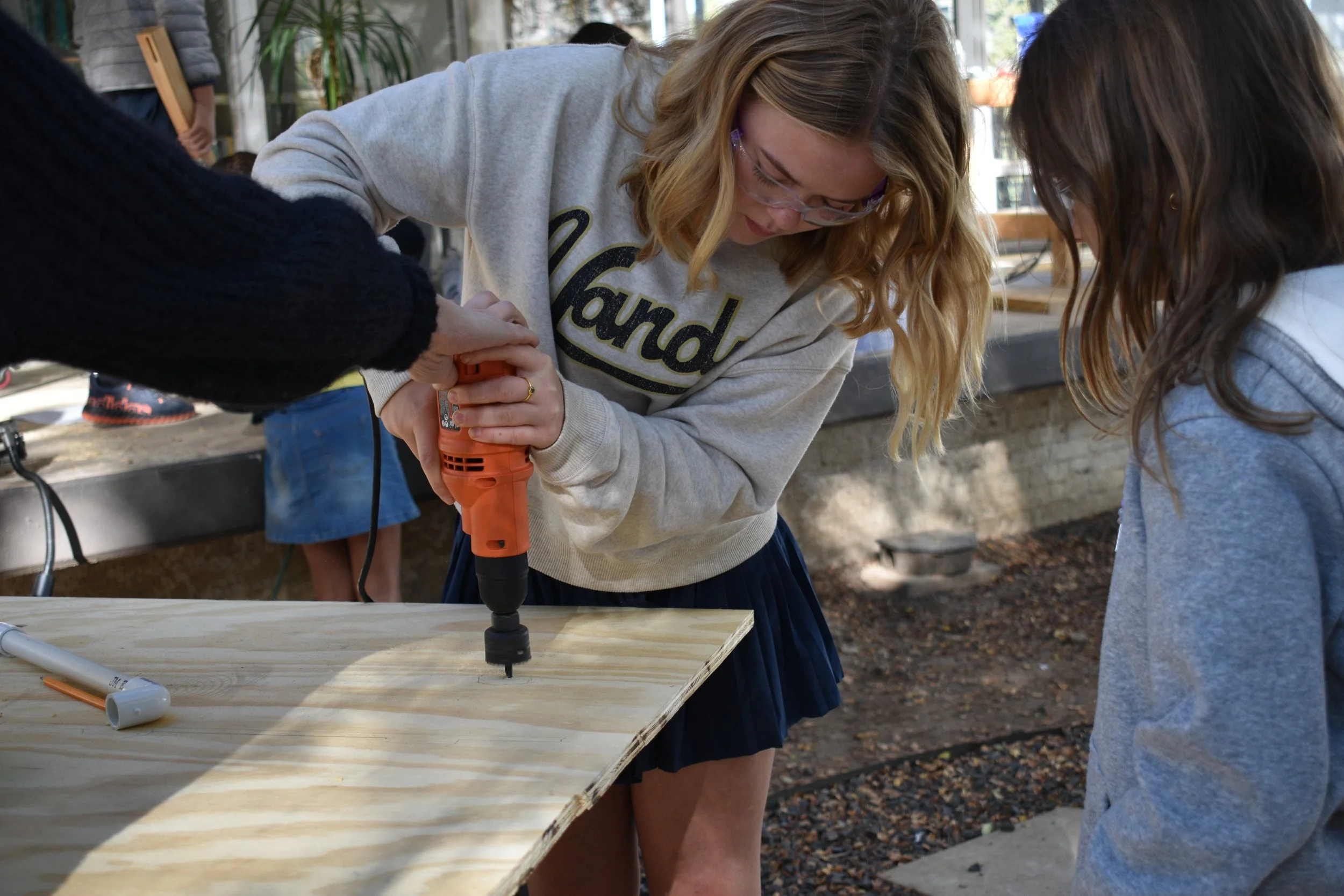
But the regatta is about much more than launching boats on the water. It’s a hands-on exploration of physics, problem-solving, and resilience. Over several weeks, teams worked together to design, build, and refine their boats, learning firsthand about buoyancy, balance, and resilience….

Read More
Rethinking “Soft Skills”: Why the Hardest and Most Enduring Skills Need a New Name

Walk into any classroom or workplace today, and you’ll likely hear talk of “soft skills.” Communication, empathy, collaboration, adaptability—these are the qualities that shape how we relate to one another and navigate the world. Yet, the term “soft skills” does these abilities a disservice. Not only are these skills among the hardest to master—and teach—but they are also the most durable, especially as technology, including artificial intelligence, rapidly reshapes our world.

The Case for a Rebrand of “Soft Skills”

The phrase “soft skills” suggests something secondary or optional—a nice-to-have alongside the so-called “hard” skills of math, science, technical expertise, or other “academic” knowledge. But research consistently tells a different story. The World Economic Forum’s Future of Jobs Report (2023) identifies analytical thinking, creativity, and resilience—alongside empathy and collaboration—as the most in-demand skills for the future workforce. These are not peripheral; they are central and it is a disservice to call them “soft”….

Read More
Build Week 19: Helping Malin Prepare for her 1st Birthday Party

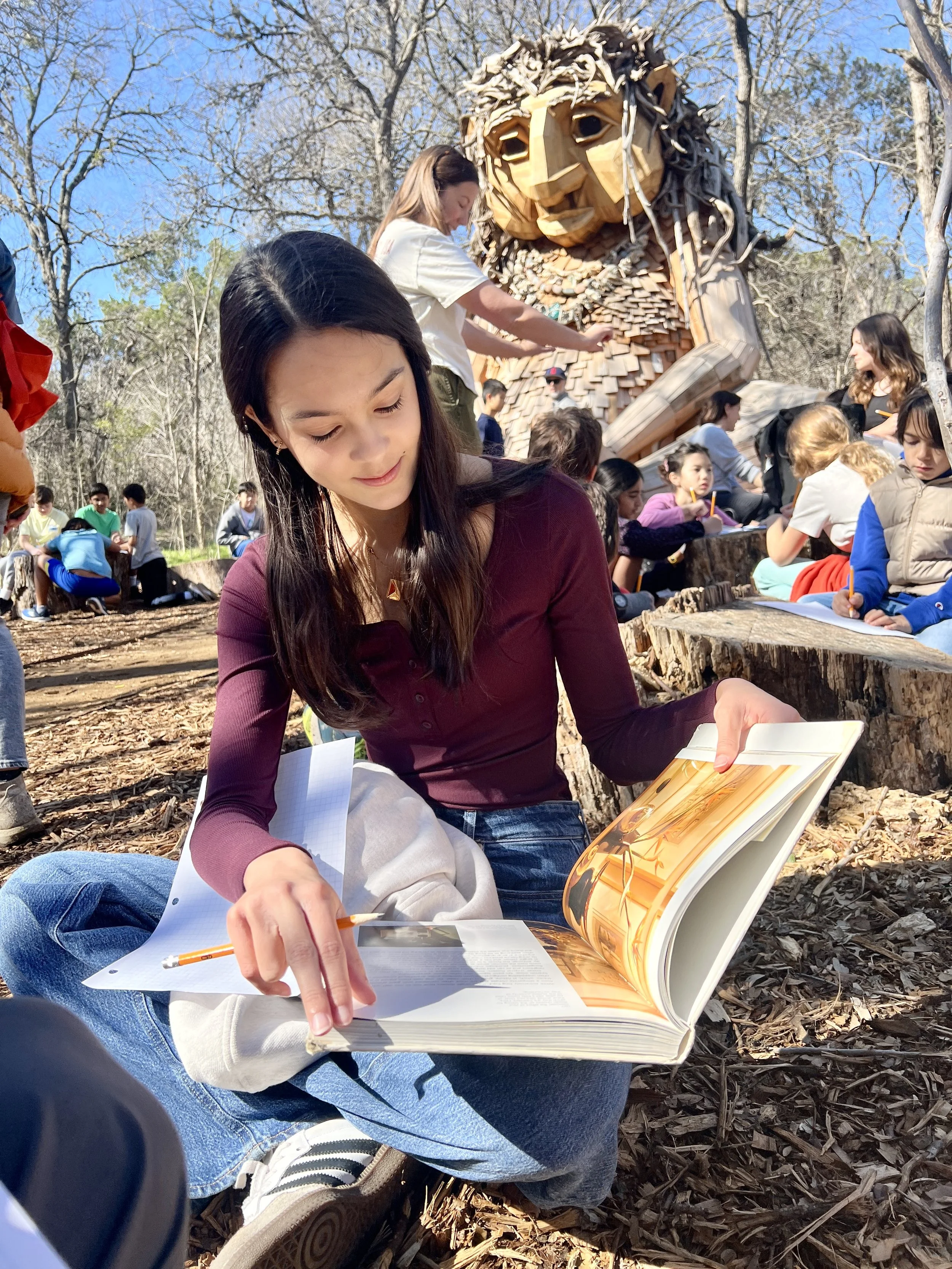
Last spring, we were thrilled to make our first visit to Pease Park’s newest (and largest) resident: Malin, the troll. Designed and built by artist Thomas Dambo, primarily from reused and upcycled materials, Malin joins over 150 other trolls created by Dambo, his team, and local volunteers for locations around the world. 

Pease Park occupies a special place in our hearts at Long-View. Every school day, we walk there for lunch and an hour of play, and often for special projects like nature writing or ecology studies. We were commissioned by Pease Park Conservancy to help Malin prepare for her 1st birthday party, and Build Week 19 was born! We were eager to help our beloved park by designating a week to build a set of colossal, upcycled decorations….

Read More
Long-View’s Perspective and Stance on Technology, Social Media and AI

Over the course of the last year, the Long-View teaching team spent a great deal of time thinking about technology use within the age bracket of our children at Long-View. While we want to teach our kids how to harness technology and leverage it for future work/career, we are also concerned about the negative impacts of daily technology use on young brains and on children’s social systems. The negative effects seen at Long-View are typical of what all schools experience such as tired kids or pre-teens who are hurt by interactions with friends via social media.

In addition, the AI surge has really caught our attention as we work to teach independent, critical thought. We are doing everything we can at school to talk about these issues and to teach productive and safe usage of technology.

We have compiled our thoughts on select topics—the ones that impact children and school life the most. We ask that families at Long-View, as well as prospective parents, join us in helping our community take a stronger stance….

Read More
Build Week 18: Working to Improve the Lives of Animals in Captivity

It’s Thursday afternoon, and Build Week 18 starts with a call to action. Kenya Bostic, a certified veterinary technician and an animal enrichment expert from The Wild Animal Sanctuary in Colorado, calls in via Zoom to teach us about why animals in captivity so sorely need enriched environments that replicate the cognitive and physical challenges they would experience in the wild. She asks us: “How could you support animals in your community in this way?” We’ll answer the call across the course of the next week, as we build enrichment items for animals who need them at Austin Nature and Science Center, a haven in Zilker Park for a small group of native Texas animals who are disabled or otherwise unsuited to life in the wild….

Read More