The Singing Bowl
This is a beautiful personal narrative written by one of our nine-year-old learners in our first writing unit of study. It so eloquently describes one of the many magical parts of our days at Long-View.
THE SINGING BOWL
Gooooong! I picked up the short, sturdy bamboo stick and rang the bowl. It’s a golden bowl that sits on a cushion. It is small and deep. And the bowl was imported from India. The singing bowl is the signal of the beginning of a day in Long-View Micro School…
Read More
Thoughts on Homework
Homework. Why is it all so important anyway? After all the hours you devoted to it, you barely remember any of it. Had it not been for your child having to go through elementary school as you had once, you would have been content to live without ever having to experience any of the information again. So, once again, why are children subjected to this? What is to be gained?
At Long-View Micro-School, we have committed to rethinking school, which also means that we have committed to rethinking homework. We do not assign homework at Long-View....
Read More
Developing Key Ways of Thinking in Science Block
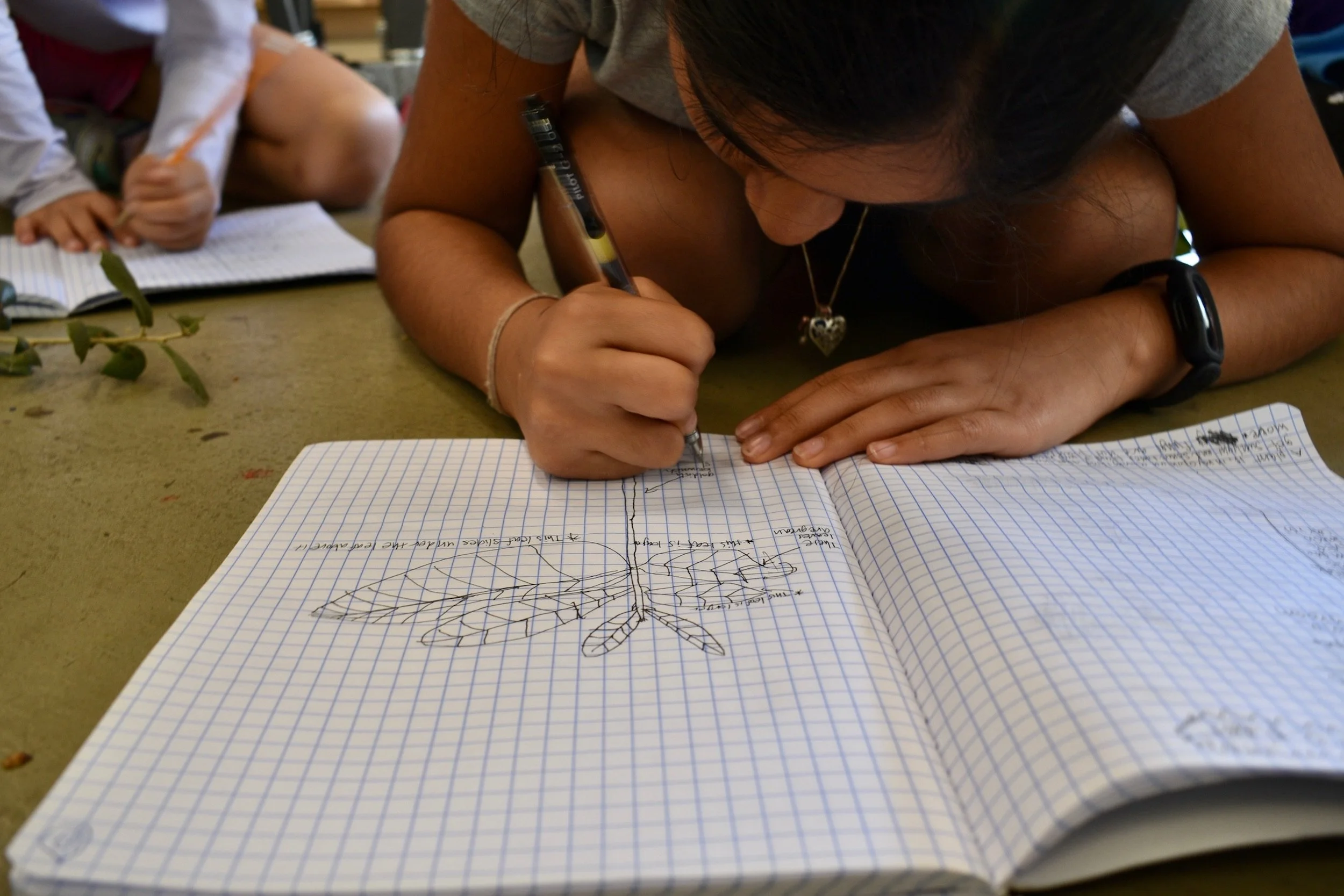
Since the start of the school year, Long-View scientists have been collaborating in small groups to develop their understanding of experimental design. Because we will be using these skills in our science practice all year, it is important to start off with a strong basic grasp of how to how to design and perform a fair test experiment, how to look for patterns and trends in our data, and how to make evidence-based claims that answer the questions we explore with our work. In order to support sense-making of what our data is actually revealing to us about our questions, we also spent time learning about science concepts like force, velocity, gravity and friction.
This models the approach to science that we take at Long-View....
Read More
How is it an 8-year-old can do that?
Visitors in our Long-View math classes often inquire about the ages of the children, because it is surprising to see such young children engaged in high-level content. How is it that an 8-year-old can do that?
The answer begins with letting go of developmental constraints previously imposed on young learners. Because our classrooms are multi-age and our instructional planning does not start from an assumption that children can only do as much as a generic textbook says their grade level can accomplish, we move much further and much deeper, traversing some very interesting mathematical terrain…
Read More
Big Picture Night: Long-View's Version of Open House
In Harvard Ed's magazine last month, Karen Mapp, a senior lecturer of education at the Harvard Graduate School of Education, compared traditional back-to-school events to cattle drives. Parents “start in the cafeteria to hear rules for 20 minutes about bussing and about the cafeteria before being herded to classrooms to hear more rules by teachers.” Open houses, Mapp shares, should be more linked to learning.
It's almost as if Dr. Mapp sat in on Long-View's Big Picture Night the evening of September 15th....
Read More
Reading and Writing Workshop Off to a Great Start
We have had a wonderful start to the year in literacy and are excited by what our readers and writers will accomplish this year. Our literacy block consists of reading and writing, and we use a workshop format to teach both. We stand on the shoulders of the great work of Teachers College Reading and Writing Project out of Columbia University to inspire us and inform our practices. This organization has an amazing research base and a strong focus on helping kids do the work of real readers and real writers…
Read More
Starting the Year Off With Build Week
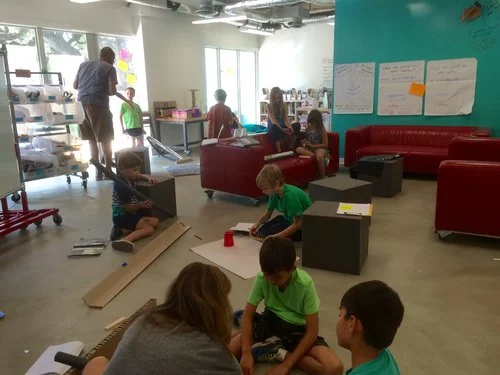
We kicked off the year with a Build Week. At Long-View, Build Weeks periodically bridge academic blocks and open our schedule up to allow us to dive into special activities and challenges. Build Weeks help us grow intellectually, help us make connections between disciplines, give us a chance to reflect and set goals, and give us an opportunity to try new things.
During this first Build Week, our focus was on building our community and building the "mindsets" that will help us learn at Long-View. Kids had the chance to try many new things and also get to know our learning environment...
Read More
A New Year Begins: Jumping for Joy
School is right around the corner and we are exited for our continued expansion! Last year we more than doubled our usable space and remodeled to create two spectacular learning labs and some small conference rooms. This year we have grown our student population and we are maxed out at 24 learners. And we can't wait to get to know them all even better! In preparation for school beginning (and because we couldn't contain our excitement) we issued the following press release:
NEW SCHOOL CHOICE IN AUSTIN: Is this the future of education?
AUSTIN,TX - August 18, 2016 - As schools open their doors this month, there is a new choice in education, a choice that is redefining education in Austin…
Read More
Making a Splash on the Last Day of School
What a day, what a year, what a fantastic group of students, what an amazing set of families, and what a forward-thinking set of educators! The 2015-16 school year has come to a close and we are grateful for a memorable year.
The story for this school year began last July, when a handful of parents said, "Can't you start a school?" (Backstory: They were intrigued with what we were doing through our work as The Number Lab, and they felt committed to our vision for education. We planned to start a school, but our launch was a year out.) When they persisted, and gave us the freedom to feel we didn't need to "fill" the school the first year and could think of it more as a prototype year, we were on board. We liked the idea of getting started, having the kids be part of the decision-making process, and iterating across the next years. We felt inspired and knew we had the opportunity to let go of old assumptions about schooling and really create something new….
Read More
Getting "Loopy" in Computer Science
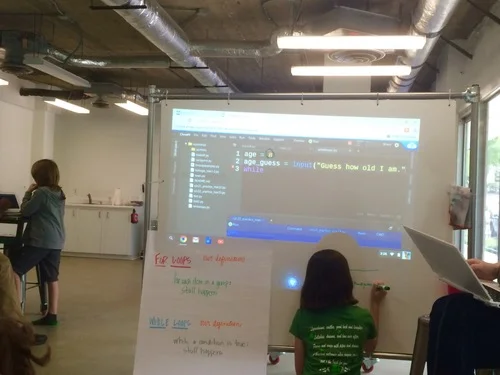
Right now in Computer Science/ Coding we are learning about a very powerful tool – loops. Loops describe when we repeat an action for every item in a group or while a certain condition is true. Thus, we have two types of loops when programming with Python – for loops and while loops.
It can be helpful to think of loops in our everyday lives. Take icing cupcakes, for example. You bake 24 cupcakes and put icing on one cupcake at a time until you have iced all 24 cupcakes. Or you add pictures to Facebook and go through each one tagging your friends’ and family members’ faces until you get through all of the pictures. Both of these are examples of for loops. For each item in the group (cupcakes, pictures, etc.), something happens to the item (the cupcake gets iced, the picture gets tagged, etc.)
While loops are a little different…
Read More